

Knowledge Hub
Blog
AI and trade association training: threat, opportunity or both?
The rise of AI and its potential impact on trade associations and the training propositions they rely on.
What are you doing today to protect your association’s position as your industry’s leading place for information, best-practice and qualifications? (10-minute read)
Since OpenAI launched ChatGPT-4 in March 2023, AIs trained on LLMs (large language models) have become ubiquitous across media reporting and have started to infiltrate every aspect of day-to-day work life. Deployed effectively, AIs like ChatGPT can supercharge productivity across several association functions - from marketing and customer services to data and reporting. Especially helpful given the total imbalance between an association’s reach within its industry and the often-modest size of an association team.
However, it also raises a potentially existential question: if AI can accurately teach my industry everything it needs to learn, why would students still come to our association to buy courses?
Although most trade associations are not-for-profits and exist only to provide value to their membership, a short conversation with any TA CEO would tell you that it is very difficult to continue increasing that value if the organisation is struggling to keep the lights on. Business models which rely solely or predominantly on membership revenue often do not generate enough to continue growing and evolving association services. That is why successful associations have created industry-specific training propositions. This is great news for association coffers, but it is also an opportunity to set high industry standards across compliance, best-practice and health & safety.
So, is there a genuine threat posed by technologies like LLMs, or is it all hyperbole and hysteria? My answer: it depends…
KSBs
My advice to any training provider wanting to create a new qualification or learning programme is always the same - as your student, what is it that I can do, what am I now capable of, since passing your course that I couldn’t do before? Because in that answer, therein lies the value of buying your course. I would argue that the harder you find it to answer this question, the greater the risk that your training offering has of being replaced by convenient but sophisticated AIs.
In learning and development, particularly apprenticeships, we often speak about Knowledge, Skills and Behaviours (KSBs). In my experience, most training programmes succeed in having all the factual, theoretical boxes ticked (the Knowledge bit), but find themselves light on the Skills and Behaviours bits. For a trade association hoping to reaffirm itself as the number one thought-leader in its industry, these two components are imperative, as they affect how I apply new information to my work, and how my behaviours evolve as a result. Storytelling can be an effective way of seamlessly flowing between all three components whilst giving context and relativity to the subject - so far, ChatGPT cannot do this.
Threats from AI aside, the above is a good rule of thumb to ensure happy, competent graduates from your training programmes.
Risk mitigation
So, in addition to having rich, multifaceted syllabuses, there are a number of things that you can start doing today to mitigate potential risks to your training propositions posed by AI.
1. Create industry-recognised accreditations
Assuming that the syllabuses and delivery mechanisms of your training are optimised, one of the smartest things an association could do is link that course - or a handful of courses - to an accreditation. This could be via a third-party awarding body (which might increase the perception of rigour and value), but I would argue that this is not always necessary. Associations have the unique benefit of effective monopolies within their industries. Creating accreditations linked to rigorous standards, well thought-out KSBs and secure formal assessment and certification is a sure way to standardise the understanding of best practice within your industry.
2. Leverage internal experience and create learning communities
Trade associations have some of the best industry experts - people who love what they do and have been doing it for a long time. Find a way of introducing forums or consortia to discuss some of the topics covered in your training programmes. Gate each forum group by qualification subject or level, and watch demand for alumni places grow. Informal training is one of the best ways of making students feel passionate about a subject and confident about their understanding. In a world increasingly driven by technological convenience, re-harness the power of human interaction.
3. Utilise technology yourself
It’s time to fight fire with fire. As a student I want training that’s just for me, just in time, and just enough.
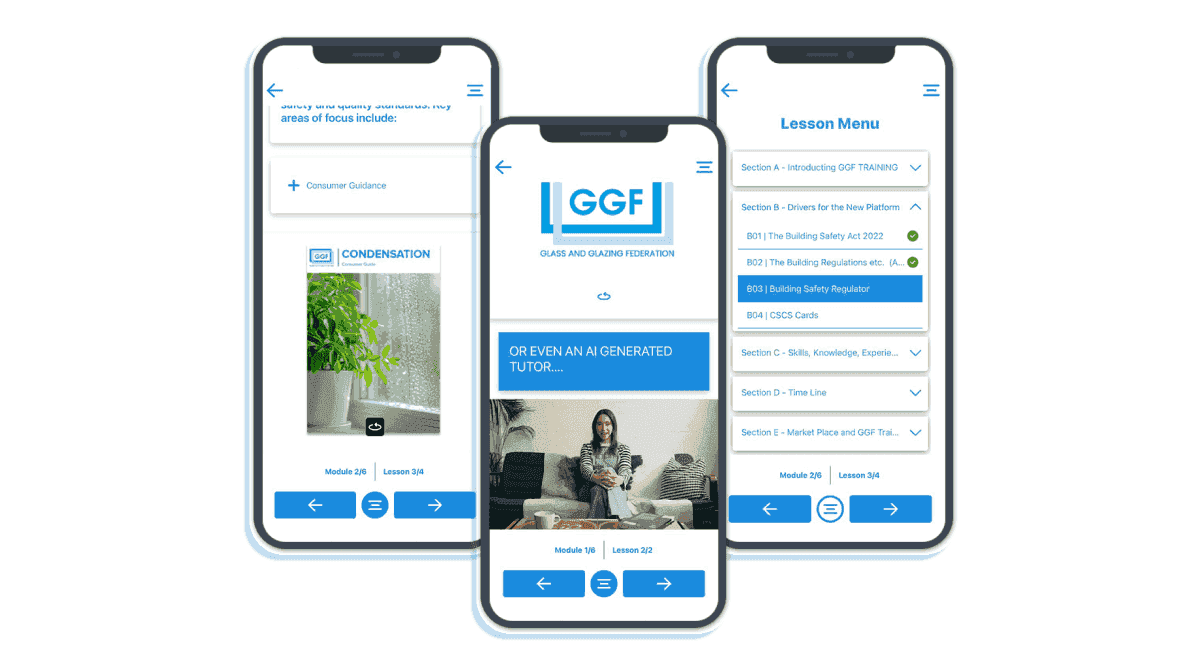
ChatGPT gets me instant answers to specific questions - but I have to know what question to ask it. By utilising technologies like Nucleus Learning, associations can modularise entire syllabuses and drip-feed information to industry stakeholders whenever they want it, wherever they are in the world, on whatever device they want to use. An effective Association Management System like Nucleus can ensure that, when it comes to your industry, there’s only one place that stakeholders need to go to learn.
If you have any questions or thoughts about the topics covered here, or would like to discuss how Nucleus could help your association modernise and prepare for the inevitable wave of digital change, we would love to speak to you.
Article written by Tom Newton, CEO of Nucleus Technologies.